Complete Technology Handbook on Agrochemical Manufacturing Technology (Industrial Production of Pesticides and Insecticides- Processes, Formulations, Plant Setup and Economics)
₹2,500 *Free Shipping + Upto 20% OFF
ISBN: 9788193971369
Why Choose Us
- More than 45 years of experience
- Managed by expert industrial consultants
- ISO 9001-2015 Certified
- Registered under MSME, UAM No: DL01E0012000
How We Work
- 24/5 Research Support Get your queries resolved from an industry expert. Ask before you purchase.
- Custom Research Service Speak to our consultants to design an exclusive study for your needs.
- Quality Assurance All reports are prepared by qualified consultants & verified by experts.
- Information Security Your personal & confidential information is always safe and secure.
Product Description
Complete Technology Handbook on Agrochemical Manufacturing Technology Industrial Production of Pesticides and Insecticides Processes, Formulations, Plant Setup and Economics
Agricultural pesticides are chemicals which are used to protect crop. They are generally divided into four categories according to the target pests:
Insecticides are targeted at insect pests. There are many kinds of insecticides in use today. They may be applied to the soil to protect roots, seeds, or seedlings. They may also be applied to the crop to protect stems, leaves, or fruit. Some of the most common insecticides include chlorpyrifos, diazinon, and carbaryl. Many insecticides kill the insects by disrupting their nervous system, resulting in paralysis and death. Unfortunately, they can have the same effect on non- target insects or fish and animals if enough of the applied product drifts or washes from the field.
Pests have affected crop production since man first started planting seeds. Crop damage from insects, fungi, and weeds can reduce yields and crop quality or even kill the crop in some cases. As a result, farmers have always sought ways to reduce this damage. Pest control using chemicals such as sulfur or plant extracts has been around for thousands of years. The first synthetic pesticides were discovered in the late s and early s and thousands have been developed since.
Pesticide use became widespread in part because the early results were so promising. Pests which farmers had battled for centuries seemed to be elimi-nated quickly and easily with these sprays. In many cases, less labor was required to produce a crop since hand or mechanical weeding was no longer necessary. As a result, yields increased and more acres could be managed by a farmer.
In this book we have explained chapterwise one by one in a very simle manner to understand students,scientists and agriculturist. The book containg various chapters on Pesticides and Insecticides which helps the budding students and entrepreneurs to set up and expand their existing units.
We finally want to thank “Engineers India Research Institute’ who gives us the platform to show our talent.
The Book covers Pesticides, Physical and Chemical Properties of Pesticides, Identity of pesticides, Physical Properties of Pesticides, Chemical properties of Pesticides, Manufacturing Process, Manufacturing Technology of Acephate, Manufacturing Technology of Aluminium Phsophade, Manufacturing technology of Captafol, Manufacturing Technology of Cypermethrin, Manufacturing Technology of DVA chloride, Manufacturing Technology of Dimethoate, Manufacturing Technology of Dichlorophenoxy acetic acid (, - D), Manufacturing Technology of Dichlorvos (DDVP), Manufacturing Technology of Ethion, Manufacturing Technology of Endosulphan, Manufacturing Technology of Fenvalerate, Manufacturing Technology of DDPA Preparation Dem Preparation, Manufacturing Technology of Monocrotophos, Manufacturing Technology of Isoproturon, Manufacturing Technology of Phosalone, Manufacturing Technology of Phorate, Manufacturing Technology of Phosphamidon,Manufacturing Technology of Zinc Phosphide, Air Pollutants From Pesticide Industry, New pesticide molecules, formulation technology and uses, Pesticidal Composition Comprising Sulphur, Acaricide and an Agrochemical Excipient, Process for commercial production of biopesticides, Biopesticide composition and process for controlling insect pests, Insecticides, Extraction of Pyrethrins From Chrysanthemum Cinerariaefolium, Production of natural insecticide from Neem leaves, New approach to synthesis of insecticide Sevin, Chlorpyrifos Synthesis via Interfacial Catalysis, Preparation of chlorpyrifos microcapsules, Preparation of benzene hexachloride, An Improved Process for Preparation of Triazophos, Nondusty spray dried mancozeb water-dispersible granules and the process for their production, Steroid insecticide extracted from kaladana and process, Plant Economics of Organic Pesticide,Plant Economics of Bio-pesticides (Mineral Oil Based) For Killing White Flies, Mini Bugs Etc., Plant Economics of Aerosol-Pesticides, Plant Economics of Insecticides From Neem Seeds, Neem Oils & Neem Leaves, Plant Economics of Pest Control (Insecticides For Rats, Termites, Rodents, Cockroaches, Moths Etc.), Plant Economics of Aerosol Insecticide Spray (Baygon, Hit, Mortein, Hexit Type)
Contents
Pesticides
- Pesticide Formulations
- Introduction
- Liquid Formulations
- Emulsifiable Concentrates (EC or E)
- Ready-to-Use Low Concentration Solutions (RTU)
- Ultra-Low Volume (ULV)
- Invert Emulsions
- Flowables (F)/Liquids (L)
- Aerosols (A)
- Ready-to-use aerosol insecticide.
- Liquid Baits
- Dry or Solid Formulations
- Dusts (D)
- Baits (B)
- Granules (G)
- Pellets (P or PS)
- Fumigant formulated as tablets (pellets)
- Wettable Powders (WP or W)
- Soluble Powders (SP or WSP)
- Other Formulations
- Microencapsulated Materials (M or ME)
- Water-Soluble Packets (WSB or WSP)
- Attractants
- Impregnated Products
- Repellents
- Animal Systemics
- Pesticide/Fertilizer Combinations
- Fumigants
- Advantages of fumigants
- Disadvantages of fumigants
- Adjuvants
Physical and Chemical Properties of Pesticides
- Definition of pesticide
- Historical background of pesticides use in agriculture and public health
- Impacts of pesticides use in agriculture and public health
- Side effects of pesticides use to the environment and public health
Identity of Pesticides
- How can pesticides be identified?
- How are the common names of pesticides derived?
- Classification of pesticides
- Classification of pesticides based on the mode of action
- Classification of pesticides based on the
- targeted pest species
- Classification of pesticides based on the chemical composition
- Other minor classes of pesticides
- Activity spectrum of the pesticide
- Mode of formulation
- Toxicity level
Physical Properties of Pesticides
- General physical properties of pesticides
- Molecular weight and form
- Vapour pressure (VP)
- Solubility
- Octanol/Water partition coefficien- Kow (Log Kow)
- Soil adsorption coefficient Koc/Kd
- Henry`s law constant-H`
- Specific physical properties of selected representative pesticides
Chemical properties of Pesticides
- Oxidation reaction of pesticides
- Reduction reaction of pesticides
- Hydrolysis reaction of pesticides
- Photodegradation of pesticides
- Biodegradation
- The Process
- The Problem
- The Solution
- Silverson Flashblend
- High Shear In-Line Mixers
- The Advantages
Manufacturing Process
- Introduction
- Pesticide Use
Manufacturing Technology of Acephate
- Acephate
Manufacturing Technology of Aluminium Phsophade
- Aluminium Phosphide
Manufacturing technology of Captafol
- Captan
Manufacturing Technology of Cypermethrin
Manufacturing Technology of DVA chloride
- Metaphenoxy benzaldehyde (MPBAD)
Manufacturing Technology of Dimethoate
Manufacturing Technology of Dichlorophenoxy acetic acid (, - D)
Manufacturing Technology of Dichlorvos (DDVP)
Manufacturing Technology of Ethion
Manufacturing Technology of Endosulphan
Manufacturing Technology of Fenvalerate
Manufacturing Technology of DDPA Preparation Dem Preparation
- Malathion Preparation
- Methyl Bromide
Manufacturing Technology of Monocrotophos
Manufacturing Technology of Isoproturon
Manufacturing Technology of Phosalone
Manufacturing Technology of Phorate
Manufacturing Technology of Phosphamidon
Manufacturing Technology of Zinc Phosphide
Air Pollutants From Pesticide Industry
- Emissions Profile in Pesticide Industries
- Solvents
New pesticide molecules, formulation technology and uses
- Introduction
- History of pesticide use
- Trends in pesticide use
- Regulation on pesticides
- Pesticide formulations
- Types of formulations
- Pesticides, non-target organisms and our
- environment
- Improvisation in pesticide use
- Monitoring for pesticide residues
- Future challenges
Pesticidal Composition Comprising Sulphur, Acaricide and an Agrochemical Excipient
- Description
- Examples
Process for commercial production of biopesticides
- Prior Art
- Final Composition of the Biopesticides
- Shelf Life
Biopesticide composition and process for controlling insect pests
- Feeding Substrate Evaluations
- Laboratory Evaluation of an Embodiment
- of the Biopesticide
- Preliminary Field Evaluation of Biopesticide
- Overwintered Adults in Early Season Cotton
- Non-Cotton Habitat Test
- Regrowth Cotton Test
- Bait Stations
- Experimental Field Trials
- Bioassays of Beauveria Bassiana, Deposit
- ATCC- (ASREF-)
Insecticides
- Organophosphate Insecticides
- Toxicology
- Signs and Symptoms of Poisoning
- Confirmation of Poisoning
- Organophosphates
- Ethoprop
- Fenamiphos
- Cadusafos
- Fosthiazate
- Other Organophosphates
- Biochemicals
- DiTera
- ClandoSan
- Sincocin
- Fumigants
- Nonfumigants
- Mammalian Anthelmintics
- Fumigation
- Irrigation
- Granules and Broadcast Sprays
- Seed Dressing and Bare Root Dip
- Effects of Temperature on Activity
- Effects of Soil Structure on Activity
- Degradation of Nematicides
- Effects on Nontarget Organisms
- Methyl Iodide and Propargyl Bromide
- DMDP
- Avermectins
- Sodium Azide
- Furfural
- Phytochemicals
- Systemic Acquired Resistance Inducers
- Hatching Stimulants and Inhibitors
- Transgenic Proteins
- Behavior-Modifying Compounds
- Steroids and Hormones
Extraction of Pyrethrins From Chrysanthemum Cinerariaefolium
- Introduction
- Plant material
- Extraction
- Quality detection
- Biological effect test
- Biological activity
Production of natural insecticide from Neem leaves
- Study area
- Preparation of the insecticide
- Statistical analysis
- Results for Application of the Prepared Insecticide
New approach to synthesis of insecticide Sevin
- Introduction
- Chemical identifying information for Carbaryl
- Routes of Sevin synthesis
Chlorpyrifos Synthesis via Interfacial Catalysis
- Introduction
- Materials and Methods
- Materials
- Methods
- General Reaction Procedure
- Instrumental Analysis
- Bench Reactor Set-Up and Batch Scale
- Results and Discussion
Preparation of chlorpyrifos microcapsules
- Introduction
- Experimental Section
- Reagents and Instruments
- Baxter Instrument Co, Ltd)
- Preparation method of chlorpyrifos microcapsules
- Determination of optimal experimental conditions
- Optimization method of raw materials ratio
- The methods of characterization
- Drawing of standard curve
- Measurement of encapsulation efficiency
- Testing methods of stability
- Storage experiment in high temperature
- Storage experiment in low temperature
- Determination of the optimal ratio of raw materials
- Determination of dispersant amount
- The results of storage in low temperature
- DDT
- The Most Famous (and Infamous) Insecticide
- The Malaria-buster
Preparation of benzene hexachloride
- Insecticides
An Improved Process for Preparation of Triazophos
- Prior or Present Art
- Synthesis of Triazophos
Nondusty spray dried mancozeb water-dispersible granules and the process for their production
Steroid insecticide extracted from kaladana and process
Plant Economics of Organic Pesticide
Plant Economics of Bio-pesticides (Mineral Oil Based) For Killing White Flies, Mini Bugs Etc.
Plant Economics of Aerosol-Pesticides
Plant Economics of Insecticides From Neem Seeds, Neem Oils & Neem Leaves
Plant Economics of Pest Control (Insecticides For Rats, Termites, Rodents, Cockroaches, Moths Etc.)
Plant Economics of Aerosol Insecticide Spray (Baygon, Hit, Mortein, Hexit Type)
List of Tables
Table Estimated % losses caused by pests in some world's major crops per year
Table Pesticides use and the corresponding crop yield in some countries/areas
Table Classification of pesticides based on the target organisms
Table . Specific physical properties of selected representative pesticide
Table .: Production of Technical Grade Pesticides
Table .: Product and associated priority pollutants
Table .: List of Solvents used in manufacturing process of pesticides
Table .: The effect of different concentration of Pyrethrins extract on flour beetle
Table .: The biological activity results( Energy and Environmental Research Center)
Table : Bites Received before Application of Insecticide.
Table : Bites received moments after Application
Table :The Adverse Effect of Using Synthetic Insecticide
Table : The Adverse Effect of Using the Prepared Insecticide
Table :Effects of Prepared Insecticide
Table.. - Reported data on CPFS synthesis via NaTCP and DETPC condensation concerning the use of PTC's, TA and solvents system.@
Table . - Optimum reaction parameters for chlorpyrifos n-propyl homologue synthesis.
Table . - Optimum reaction parameters for chlorpyrifos n-butyl homologue synthesis.
Table . The amount of wall materials in each experiment
Table . The effect of different amount of core material and wall materials on the microcapsule size and encapsulation efficiency
Table .. The effect of different amount of poly(vinyl alcohol) on microcapsule size and encapsulation efficiency
List of figures
Fig. .: Typical Unit operations of Chemical Synthesis
Fig. .: Process Flow Diagram of Acephate Manufacturing
Fig . : Process Flow Diagram of Aluminium
Phosphide Manufacturing
Fig. .: Process Flow Diagram of Captan Manfuacturing
Fig. .: Process Flow Diagram of Cypermethrin Manufacturing
Fig. : Process Flow Diagram of Dimethoate Manufacturing
Fig. : Process Flow Diagram of , - D Acid Manufacturing
Fig. .: Process Flow Diagram of D.D.V.P. Manufacturing
Fig. .: Process Flow Diagram of Ethion Manufacturing
Fig. .: Process Flow Diagram of Endosulphan Manufacturing
Fig. . A. Process Flow Diagram (step PCT to D/PCBC)
Fig. . C. Process Flow Diagram (step C/PCCN to
D/PCAN)
Fig.. D. Process Flow Diagram (step D/PCAN to D/PCACl)
Fig. . E. Process Flow Diagram of Fenvalerate
Fig. .: Process Flow Diagram of Malathion manufacturing
Fig.. Process Flow Diagram of Methyl Bromide Manufacturing
Fig. .: Process Flow Diagram of Monocrotophos Manufacturing
Fig .: Process Flow Diagram of Isoproturon Manufacturing
Fig. .: Process Flow Diagram of Phosalone Manufacturin
Fig. : Process Flow Diagram of Phorate Manufacturing
Fig.: Process Flow Diagram of Phosphamidon Manufacturing
Fig. .: Process Flow Diagram of Zinc Phosphide Manufacturing
Figure .: Chrysanthemum cinerariaefolium Flowers
Plant material
Extraction
Diagram . : The extraction steps of Pyethrins from C. cinerariafolium.
Figure : Chemical structure of Azadirachtin.
Figure. .: CPFS synthesis reaction scheme.
Figure. .: Reaction progress photographs (A) Initial (B) Intermediate (C) Final.
Figure. . - NIS catalyst recyclability for chlorpyrifos n-propyl homologue synthesis.
Figure . - NIS catalyst recyclability for chlorpyrifos n-butyl homologue synthesis.
Figure . The standard curve of chlorpyrifos
Figure . The states of sample of test in high temperature
Figure . . The states of sample of test in low temperature
Another Book for kind reference:
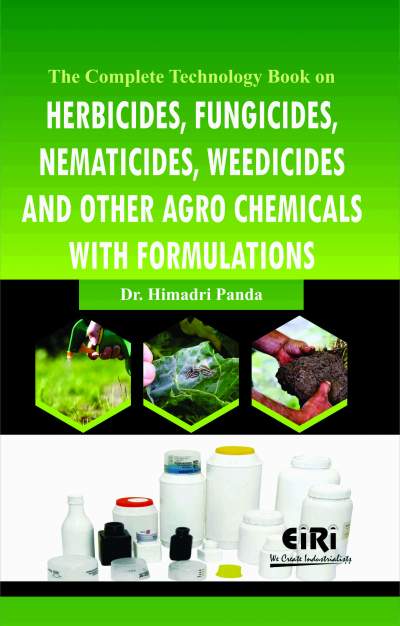
The Complete Technology Book on Herbicides, Fungicides, Nematicides, Weedicides and other Agro Chemicals with Formulations
Herbicides are used to control weeds in crops. Up to % of all pesticides sold are herbicides and they are used in most crop production systems. Weed control is one of the most effective practices to increase yields. Herbicides can be selective, killing the weeds but not the crop, such as atrazine in corn or trifluralin in soybeans. Other herbicides, such as glyphosate or paraquat, are non-selective, killing all plants they contact except those genetically engi-neered to be resistant to that particular herbicide or those that have developed resistance due to selection by the herbicide. Many herbicides have relatively low toxicity to insects, fish, or animals because they target specific enzyme systems found only in plants . This is particularly true for newer herbicides.
Fungicides are used to control fungi which cause disease in crops. They are applied to seeds, to soil, or to the crop to prevent or slow disease when condi-tions are favorable for the fungus. Fungicides are used primarily on high-value food crops and in turf and ornamental plant maintenance. They generally kill the fungal spores before they can germinate and infect the plant. Fungicides such as benomyl, metalaxyl, and chlorothalonil are used for a wide variety of crops, turf, and ornamental plants.
Nematicides are targeted at nematodes which infect plant roots and stunt or kill the crop. They are always applied to the soil as that is where the target occurs. Nematicides are generally non-selective, killing most everything they contact in the soil.