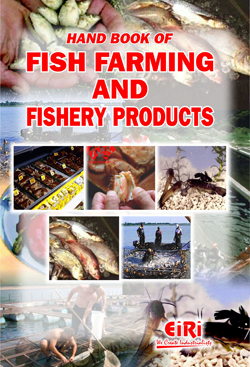
Fish farming is one of the fastest-growing segments of food production worldwide, driven by rising protein demand and the limits of wild-catch fisheries. Aquaculture lets an entrepreneur produce a high-value protein on a defined footprint, with strong domestic markets and, for many species, serious export demand. Coastal and inland regions across South Asia and Africa are well suited to it, and value addition through processing turns fresh fish into higher-margin, longer-life products.
These handbooks cover fish farming and marine product processing, prepared by EIRI's consultants with more than 45 years of industrial project experience, so an entrepreneur can understand production and processing before investing.
The core guide is the handbook of fish farming and fishery products, covering aquaculture production and the processing of fish and fishery products. For entrepreneurs looking at protein processing more broadly, the modern technology of fresh processed meat and coated poultry products covers adjacent meat and poultry processing, which shares much of the cold-chain and processing infrastructure with fish.
The fish farming handbook covers species selection, pond and tank systems, water management, feed, disease control and the processing of fishery products, along with the economics of an aquaculture operation. The processed-protein handbook covers processing methods, plant and machinery and formulations for value-added meat and poultry products. Together they address both the production and the value-addition sides of the protein business.
Fish and marine product processing requires an FSSAI licence in India and equivalent food-safety approval elsewhere. Aquaculture operations may require water-use, environmental and coastal-zone approvals depending on location and system. Export of marine products carries the destination market's own standards, which are often strict. Government schemes sometimes support aquaculture and fisheries. Confirm the applicable requirements before investing.
Aquaculture can be profitable given rising protein demand and strong export markets for many species. Returns depend on species choice, water and feed management, disease control and market access. The handbook helps you assess these before committing to a system and scale.
Not necessarily. Inland freshwater aquaculture in ponds and tanks is widely practised, while coastal and brackish-water systems suit other species. The right system depends on your location, water availability and target species.
In India, an FSSAI licence is required for fish and marine product processing, and aquaculture may need water-use and environmental approvals. Export carries the destination market's standards. Confirm the current requirements for your location and product.
Yes, marine and aquaculture products have significant export markets, though these apply strict quality and traceability standards. Building compliance into the operation from the start is important for export-oriented ventures.
Yes. Alongside these handbooks, EIRI prepares customised Detailed Project Reports for fish farming, aquaculture and marine-product processing units, suitable for finance and scheme applications and matched to your capacity and location.
Browse the handbooks above to find the guide for your intended venture. Each can be purchased and downloaded, or request a free sample to review the depth first. For bank-ready project reports or customised documentation, send us your requirement.
Speak with our experts and get personalized guidance for your manufacturing business idea, project planning, machinery selection, and investment strategy.