"Mineral water plant" is one of the most searched manufacturing business ideas in India, and for good reason. Clean packaged drinking water is a daily necessity, demand runs year-round and climbs with every summer, urbanisation and travel, and distrust of ordinary tap water keeps pushing households, offices, shops and events toward sealed bottles and jars. For an entrepreneur, it is a business you can size to a defined local market and scale from there. But it is also a business where one thing — mandatory certification — separates a licensed, trusted brand from a plant that cannot legally sell a single bottle. This guide covers what actually matters: the licensing, the machinery, and the costs that decide viability.
First, a Distinction That Matters: Packaged Water vs Mineral Water
In everyday speech people say "mineral water," but in India these are two legally distinct products. Packaged drinking water is treated water — typically borewell or municipal water purified by reverse osmosis and disinfection — and it is what the large majority of "mineral water plants" actually produce. Natural mineral water comes from a protected natural source with its own mineral content and is bottled with minimal treatment, which requires access to a genuine spring or natural source. For almost every new entrant, the realistic business is a packaged drinking water plant. The distinction matters because the two carry different standards, and knowing which you are setting up is the first step.
The BIS Licence: The Make-or-Break Requirement
This is the single most important thing to understand before you spend anything. In India, packaged drinking water and mineral water are among the products for which BIS certification (the ISI mark) is mandatory — packaged drinking water under IS 14543 and natural mineral water under IS 13428. You cannot legally sell the product without it. On top of BIS, you need an FSSAI licence, because it is a food product, and you must meet defined water-quality and testing standards on an ongoing basis.
The practical implication: certification is not a formality you tidy up at the end. It drives your plant design, your in-house testing laboratory, your water-treatment specification and your documentation from day one. Many first-time entrepreneurs underestimate the time and process involved in securing the ISI mark, which is precisely why it belongs at the centre of your planning, not the margin. Requirements and standards are periodically updated, so confirm the current position with BIS and your FSSAI authority before committing.
The Manufacturing Process
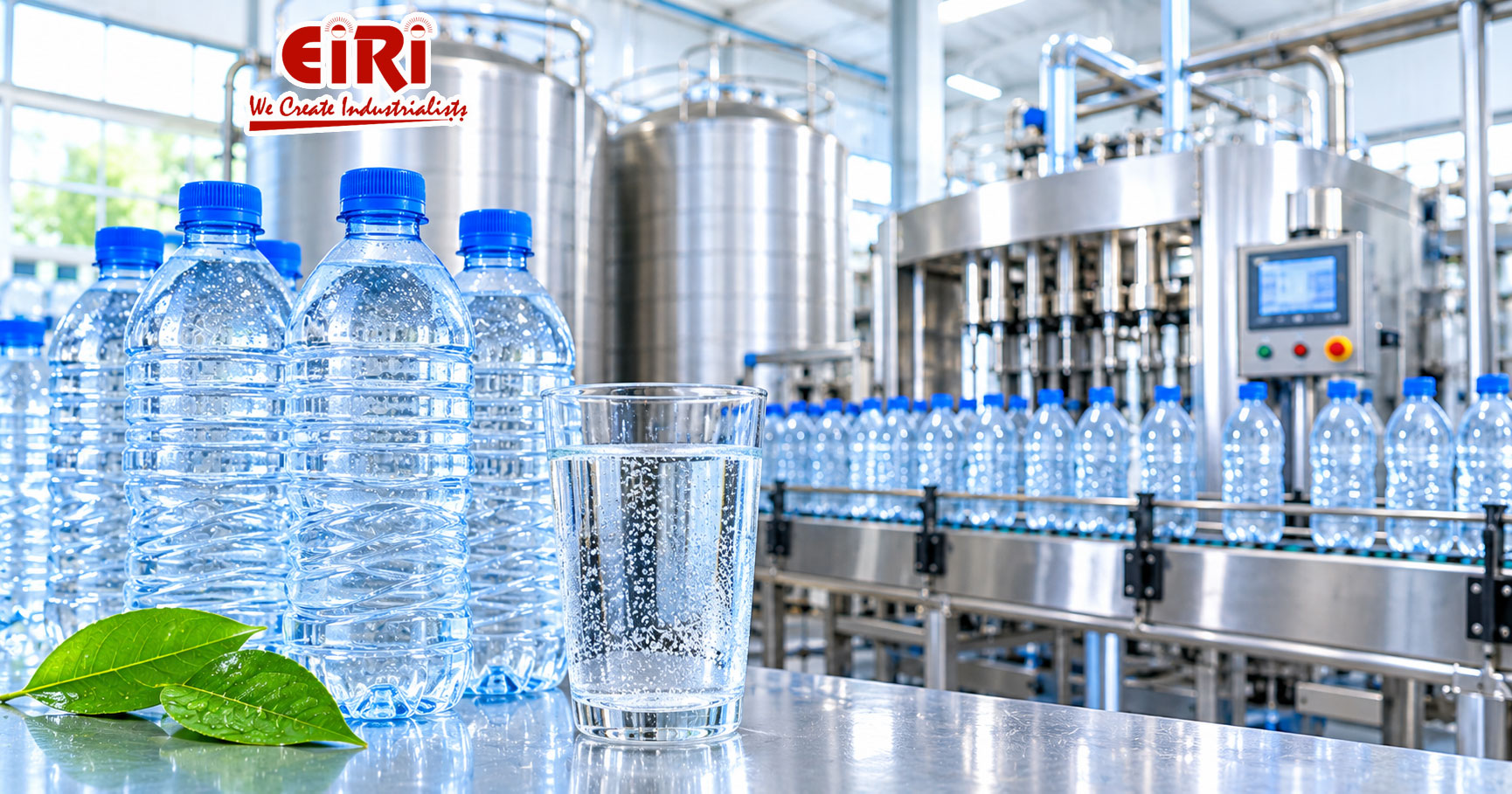
A packaged drinking water plant is, at its core, a water-treatment line followed by a bottling line. Raw water — usually from a borewell — is drawn and stored, then passed through a treatment train: sand and carbon filtration to remove particulates and odour, reverse osmosis to remove dissolved solids and contaminants, and disinfection by ultraviolet treatment and ozonation to ensure microbiological safety. The treated water is stored in food-grade tanks, then moved to the filling line, where bottles or jars are washed, filled, capped, labelled and packed. Quality testing runs throughout, which is why an in-house lab is not optional — it is part of both the process and the certification.
The Machinery You Will Need
The plant is built around a line rather than a single machine. The core items are the raw-water storage and pre-treatment units (sand and carbon filters), the reverse-osmosis (RO) plant sized to your output, UV and ozonation disinfection systems, food-grade treated-water storage tanks, and the bottling section — bottle rinsing, filling and capping machinery, labelling, and packing. Capacity scales with the RO plant and the filling line, and the product mix matters: a plant doing 20-litre jars for the bulk market uses different filling equipment from one doing 500 ml and 1-litre retail bottles, and many plants run more than one line. An in-house testing laboratory with the required instruments completes the setup.
What Drives the Cost
We will not quote a single investment figure, because it varies widely with capacity, the bottle and jar sizes you produce, the RO plant size, land and building, and whether you blow your own PET bottles or buy them in. What is worth understanding are the cost drivers: the RO and treatment capacity, the filling-line automation level, the building (a hygienic, approved premises is required), the borewell and raw-water arrangement, and the testing lab. Packaging — bottles, caps, labels, shrink-wrap — is a major recurring cost, and the decision to make or buy PET bottles materially affects both capital and running cost.
On the returns side, packaged water is a volume business with modest per-unit margins, so throughput, plant utilisation and distribution efficiency matter more than any single markup. One honest point worth internalising: at the small, owner-run end, the binding constraints on a water plant are rarely the machinery — they are the BIS licence, the cost of bottles and jars, and a tight delivery radius. Size the plant to a market you can actually reach.
Site Selection and the Water Source
Two locational factors shape the economics. First, a reliable raw-water source of adequate quality — usually a borewell — because water quantity and quality determine both treatment cost and viability, and borewell and groundwater use may require its own approvals. Second, proximity to the distribution market, since water is heavy and freight on a low-value, high-volume product bites quickly. A plant well-placed between a good source and its market has a structural advantage.
Understanding the Business Before You Invest
Packaged drinking water is one of the most accessible manufacturing opportunities in India, but it rewards getting the fundamentals right — certification, water treatment and distribution — rather than simply installing machinery. A solid grounding in the technology helps you plan properly, and our packaged drinking water business books — including the dedicated handbook on the technology of water and packaged drinking water — cover the treatment process, plant and machinery, quality and testing requirements, and the economics of a bottling operation as a practical reference.
What a Bankable Plan Needs
Like any manufacturing venture seeking bank finance, a mineral water plant is judged on a documented plan: the intended capacity and product mix, the treatment and bottling machinery and its cost, the BIS and FSSAI compliance pathway, the water source, building and utilities, working capital, and realistic financial projections. The projects that struggle usually underestimated the certification process or mis-sized the plant against the local market. Getting that plan right before you order a single machine is what separates a plant that runs from one that stalls.
Ready to Take the Next Step?
When you are ready to turn the idea into a real, financed project, EIRI can prepare a Detailed Project Report for your packaged drinking water plant — built around your capacity, your product mix and your location, and in the form banks and scheme offices look for. Just send us your requirement with the capacity you have in mind, and we will come back to you with the scope and the next step. Send us your requirement.
When it is time to put real numbers to the plan, this packaged drinking water project profile is a useful place to go next. Alongside the investment worked out for plant sizes from about 4,000 to 12,000 litres a day, it carries the market demand picture, a directory of machinery and raw-material suppliers (bottles, caps and jars), and ready DPR and CMA reports you can take to a bank. For a first plant, having the supplier list and the loan paperwork in one place saves a lot of running around.
Frequently Asked Questions
Is a mineral water plant profitable in India?
Packaged drinking water has universal, year-round demand that grows with urbanisation, travel and summer heat, and a plant serving its local region has a steady market. It is a volume business with modest per-unit margins, so profitability depends on throughput, plant utilisation, packaging cost and distribution efficiency rather than a large markup, and on maintaining certification.
What licence is required to start a mineral water plant?
In India, BIS certification (the ISI mark) is mandatory — packaged drinking water under IS 14543 and natural mineral water under IS 13428 — and you cannot legally sell without it. You also need an FSSAI licence, since it is a food product, plus compliance with water-quality and testing standards. Borewell or groundwater use may need separate approval. Confirm the current requirements with BIS and your FSSAI authority before investing.
What is the difference between packaged drinking water and mineral water?
Packaged drinking water is treated water — typically borewell or municipal water purified by reverse osmosis and disinfection — and is what most plants produce. Natural mineral water comes from a protected natural source with its own mineral content and requires access to a genuine spring. They carry different Indian standards (IS 14543 and IS 13428). For most new entrants, a packaged drinking water plant is the realistic business.
What machinery is needed for a packaged water plant?
The core line is raw-water storage and pre-treatment (sand and carbon filters), a reverse-osmosis plant, UV and ozonation disinfection, food-grade storage tanks, and the bottling section — bottle rinsing, filling, capping, labelling and packing — plus an in-house testing laboratory. Capacity scales with the RO plant and filling line, and the equipment depends on whether you make jars, retail bottles, or both.
How important is the water source and location?
Very. A reliable raw-water source of adequate quality, usually a borewell, determines treatment cost and viability, and groundwater use may require approval. Proximity to the distribution market also matters because water is heavy and freight on a low-value, high-volume product adds up quickly. A plant well-placed between a good source and its market has a real advantage.