How to Start a Cotton Ginning Business in India: Process, Machinery, Cost and 2026–2030 Outlook
India is one of the world's largest cotton producers, and almost every boll of that crop passes through a ginning mill before it becomes anything else. Ginning — separating cotton fibre (lint) from seed — is the first processing step after cultivation, and it sits at a natural chokepoint in the supply chain: ginners buy raw kapas from farmers and sell lint to spinning mills and cottonseed to oil extractors. For an entrepreneur in a cotton-growing belt, that position offers steady, seasonal, locally-rooted demand.
It is also a sector in the middle of a policy-driven upgrade cycle. A five-year national cotton mission worth over Rs 5,600 crore, now running from 2026-27, puts ginning modernisation and contamination control at the centre of India's plan to fix its fibre quality problem. Meanwhile the country's spinning capacity is consuming more cotton than it grows, and the textile industry is targeting a doubling in size by 2030. For a well-sited, well-equipped ginning unit, those two facts define the opportunity. This guide walks through what starting a cotton ginning unit actually involves — the process, the machinery, the costs that drive viability, the licences you will need, and where the industry is heading.
What Cotton Ginning Actually Is
Raw harvested cotton, called kapas or seed cotton, is roughly one-third fibre and two-thirds seed by weight. A ginning mill mechanically separates the two. The lint is cleaned, pressed into standardised bales and sold to textile spinners; the cottonseed goes to oil mills for extraction. Modern Indian ginning is dominated by the double-roller (DR) gin, well suited to the medium and long-staple cottons grown across the country, though saw gins are used for certain varieties.
The sequence runs: kapas intake and pre-cleaning, feeding to the gins, separation of lint from seed, lint cleaning, and finally baling and pressing into bales of a standard weight for the market. Seed is collected separately for sale. The whole operation is seasonal, concentrated around the cotton harvest, which makes working capital timing — buying a season's kapas when it arrives — the single most important financial discipline in the business.
One number worth understanding before you plan anything else is ginning outturn (GoT) — the percentage of lint recovered from a given weight of kapas. It varies by variety, by region and by how well the machine line is set up and maintained. A point or two of outturn, multiplied across a season's throughput, moves the annual result far more than most operators expect, which is why machinery condition and process discipline are commercial questions rather than technical ones.
The Indian Ginning Sector in 2026: Where Things Stand
India has historically been served by a large, fragmented ginning base — estimates have long put the number of ginning factories at roughly 4,000, mostly in rural and semi-urban locations and mostly micro, small or medium enterprises. Government modernisation planning now works with a core of around 2,000 ginning and processing factories, which is the number the current cotton mission aims to cover with upgrade and training support.
That fragmentation is the sector's defining feature. A minority of units are fully automatic composite plants with 24 or more double-roller gins, pneumatic conveying, automatic bale handling and covered kapas storage. A much larger number run older lines with manual handling and weaker contamination control. The gap between the two groups is now commercial, not cosmetic: spinning mills supplying export-oriented garment manufacturers increasingly discriminate on trash content, contamination and bale consistency, and they pay accordingly. Contamination — polypropylene fibre from packing material, hair, dust — enters lint at the ginning stage and is practically impossible to remove economically afterwards.
The demand side has tightened sharply. Indian mills now consume more cotton than Indian farms produce. Through the 2025-26 season the Cotton Association of India progressively revised the crop upward to around 339 lakh bales of 170 kg, well above the previous season, yet estimated consumption at roughly 348 lakh bales and imports at around 62 lakh bales. For the 2026-27 season now under way, a weak monsoon has clouded the picture: the USDA's Mumbai post cut its forecast to about 24.5 million bales of 480 lb from 11.5 million hectares, with yields down on below-normal rainfall, while raising its mill-use forecast on the strength of textile and apparel export orders. Industry estimates circulating at the start of the season put output below 290 lakh bales against projected consumption above 340 lakh bales.
For a ginner, a structural supply deficit is a double-edged fact. It means lint has a reliable buyer and firm prices. It also means kapas is contested, procurement is competitive, and a unit without secured arrivals in its catchment can end up with idle capacity in a season when everyone else is running full.
The Machinery You Will Need
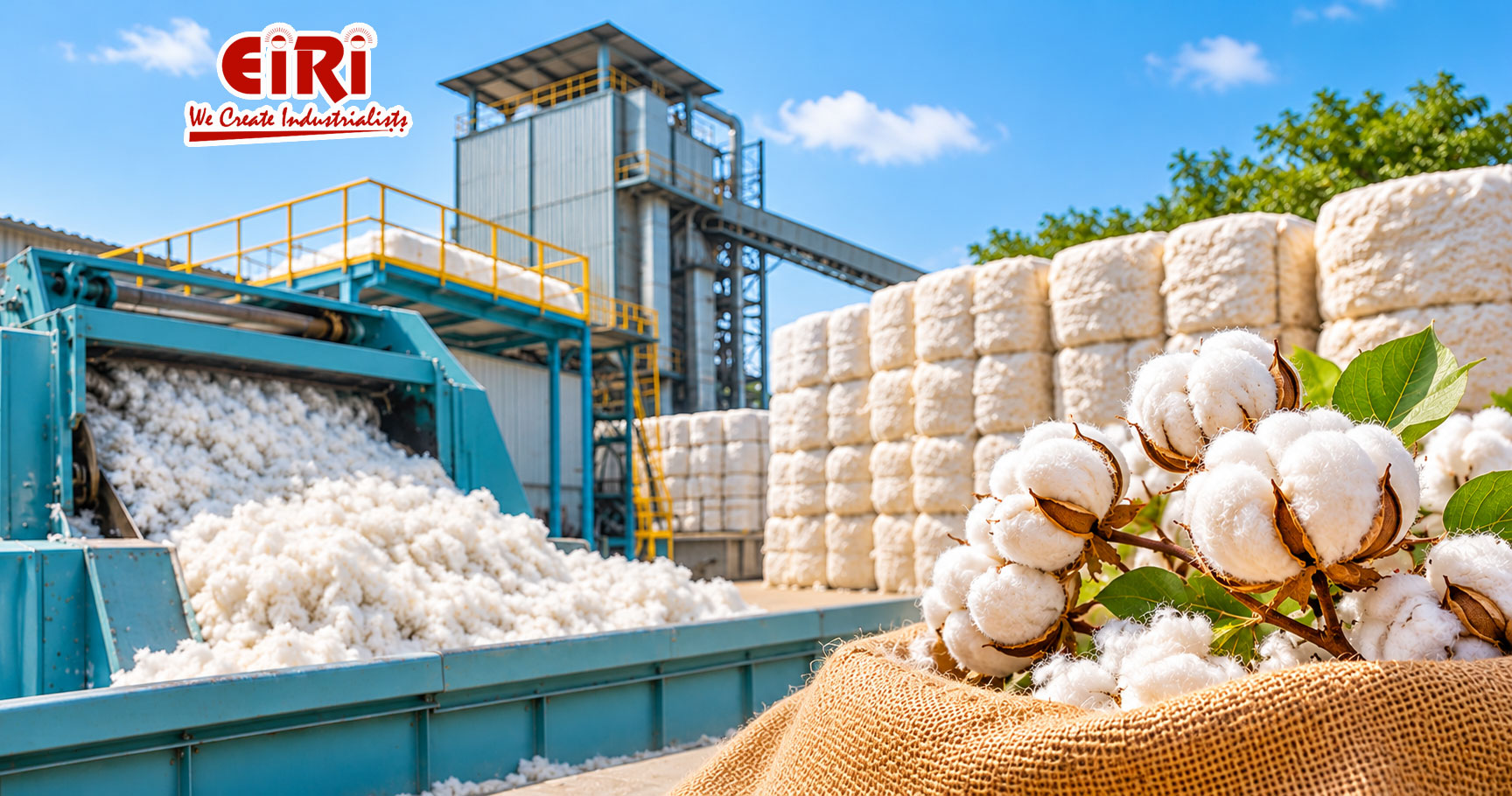
A cotton ginning and pressing unit is built around a line of equipment rather than a single machine. The core items are double-roller ginning machines (the number of gins determines capacity), pre-cleaning and lint-cleaning machinery to remove trash and improve grade, a bale press for compressing lint into market-ready bales, and the conveying, elevating and dust-handling systems that move material through the line. Many units integrate a pressing (baling) section directly, which is why the business is often described as a "ginning and pressing" or "ginning and pressing factory."
Capacity is usually expressed in bales per day, and it scales with the number of gins installed. Indian plants today span a very wide range, from modest units of a few dozen bales a day to large composite factories running on multiple presses across three shifts. The right size depends on how much kapas your catchment area produces and how much working capital you can commit during the buying season — an oversized plant that cannot be fed is a common and expensive mistake, which is one of the strongest arguments for a proper feasibility study before ordering machinery.
Two further specification decisions deserve attention at the planning stage rather than later. The first is contamination control: covered and paved kapas storage, pneumatic conveying in place of manual handling, pre-cleaning capacity matched to the trash level of local cotton, and in-house moisture and trash testing. These are the items that determine whether your bales command a premium or a discount, and whether your unit can eventually qualify for certification programmes. The second is power: ginning and pressing are energy-intensive, motor efficiency and the quality of the drive and conveying design directly affect cost per bale, and electricity load sanction is a long-lead item that should be initiated early.
What Drives the Cost and the Returns
Ginning is a thin-margin, high-throughput business. The money is made on volume and on the spread between kapas bought and lint-plus-seed sold, not on a large markup. That makes three cost factors decisive. First, raw material: kapas is the overwhelming share of cost, and buying well during the season determines the year. Second, working capital: because buying is concentrated into the harvest window, the finance needed to purchase a season's cotton typically far exceeds what an annual-average calculation suggests. Third, power and utilities, since ginning and pressing are energy-intensive.
Byproduct value matters more than newcomers expect. Cottonseed is not waste — it is a genuine revenue stream feeding the edible oil industry, and the economics of a ginning unit improve markedly when seed sales are properly accounted for. With seed making up around two-thirds of kapas by weight, and with cottonseed oil cake carrying its own established market as animal feed, seed realisation is a material line in any honest projection. Some operators integrate forward into cottonseed oil extraction to capture that value directly; the broader economics of oilseed crushing are covered in our category on oils, fats and derivatives.
We deliberately avoid quoting specific investment or return figures here, because they vary enormously with capacity, location, land cost and the cotton price in any given season. A realistic, bankable number for your specific plan comes from a detailed project report built around your intended capacity and region — not from a generic figure online.
Policy and Price Signals Every Ginner Must Track
Ginning margins are made and lost on policy as much as on operations, and three instruments move the market every season.
Minimum Support Price. For the 2026-27 season the MSP for seed cotton was raised by Rs 557 per quintal to Rs 8,267 for medium-staple and Rs 8,667 for long-staple kapas — increases of roughly 7.2 and 6.9 per cent. The MSP sets an effective floor under your raw material cost. When market prices fall below it, farmers prefer to sell to the Cotton Corporation of India, which narrows the pool available to private ginners; when market prices run above it, procurement becomes a pure commercial contest.
CCI procurement. The Cotton Corporation of India is the designated MSP procurement agency and its scale is substantial — in a recent season it procured over 105 lakh bales worth more than Rs 41,500 crore across some 24 lakh farmer transactions. CCI is simultaneously a competitor for kapas during procurement and a supplier of lint when it sells stocks. Understanding its posture in your region in any given month is a practical commercial necessity, not a policy abstraction.
Import duty on raw cotton. Imported cotton normally attracts an effective 11 per cent duty burden (basic customs duty, agriculture infrastructure and development cess, and social welfare surcharge). That duty has been repeatedly waived to help mills: an exemption introduced from 1 June 2026 was extended by notification on 30 October 2026 through to 31 December 2026. Duty-free imports ease mill input costs but also cap how far domestic lint prices can run, and arriving during the Indian harvest they put direct pressure on what ginners can realise. Any projection that assumes a single stable lint price for a full season is ignoring this.
Underlying all three is a simple fact that explains why cotton policy is so politically sensitive: cotton accounts for roughly 70 per cent of yarn manufacturing cost, around half of fabric cost and 30 to 35 per cent of garment cost. Everything downstream reacts to the fibre price, which is precisely why the government intervenes in it so often.
The Forecast: Where Cotton Ginning Is Headed to 2030
Four trends are likely to shape the economics of an Indian ginning unit over the rest of this decade.
1. Demand growing faster than supply. India's textile and apparel industry reached roughly USD 190 billion in FY26 and the stated national target is USD 350 billion by 2030, with exports rising towards USD 100 billion. Even partial achievement implies substantially higher mill consumption of cotton. Domestic production has been broadly flat for years, which is why imports have risen and why the duty exemption keeps being extended. The strategic implication for ginners is favourable: lint demand is structurally strong, and the constraint on the industry is fibre availability and quality rather than offtake.
2. A national push on productivity and ginning quality. The Mission for Cotton Productivity, approved with an outlay of about Rs 5,659 crore for the period 2026-27 to 2030-31, targets around 32 lakh farmers and — critically for this industry — explicitly covers capacity building and modernisation across roughly 2,000 ginning and processing factories, strengthened testing infrastructure, and a target of reducing contamination to below 2 per cent. Alongside it, field-level programmes are scaling high-density planting, closer spacing and extra-long-staple varieties, with improved ginning outturn among the breeding objectives. Over five years, that combination should raise both the volume and the quality of kapas reaching mills — and raise the bar for what a competitive ginning unit looks like.
3. Traceability becoming a condition of market access. Kasturi Cotton Bharat, India's national certification and branding programme for cotton, has moved from pilot to scale: certified volumes rose to roughly 2.13 lakh bales in the 2025-26 season from about 47,100 bales in 2023-24, more than 10 lakh bales have been brought onto its blockchain platform, and registered participants include textile mills buying certified lint directly. Projections associated with the programme envisage roughly 132 lakh bales qualifying as Kasturi out of an estimated 498 lakh bales of total production by 2031-32. Certification is awarded at the ginning stage, against protocols covering fibre parameters, trash, contamination and accredited testing. In other words, the premium segment of the Indian lint market is being defined by what ginners do. A new unit built to those protocols from day one is positioning itself where the margin is going; a unit built to minimum specification is positioning itself where it is leaving.
4. Consolidation toward larger composite units. The direction of travel in Indian ginning has been consistent for two decades: away from small, manual, seasonal operations and toward composite ginning-and-pressing factories with automated handling, higher daily bale capacity and in-house quality testing. Rising compliance requirements, buyer quality discrimination and energy costs all favour scale and automation. Smaller units without a modernisation path are likely to find themselves squeezed, selling into the commodity end of the market at the thinnest spreads.
Against those positives, the risks are real and should be modelled rather than assumed away. Cotton acreage competes with groundnut, pulses and other crops and shifts with relative returns. Monsoon variability moves the crop by double-digit percentages between seasons, as 2026-27 has already demonstrated. The MSP has risen faster than market prices in several recent seasons, compressing the ginner's spread from the input side. And duty-free imports, whenever extended, compress it from the output side. A ginning project that is viable only in a good crop year at a favourable spread is not a viable project.
Licences and Registrations
A ginning unit needs standard business registration and GST, Udyam (MSME) registration, factory licensing where applicable, and pollution-control board consent given the dust and fibre handling involved. Many states regulate cotton trading and may require registration with the agricultural marketing authority for buying kapas. Electricity load sanction is a practical early step given the power demand. Confirm the current requirements with your state authorities before committing, as cotton and agricultural-marketing rules vary by state.
Beyond the statutory minimum, two voluntary registrations are worth planning for. Registration under the Kasturi Cotton Bharat programme allows a unit to produce certified bales and participate in the traceability platform. The Textiles Committee's star rating scheme for modernised ginning and pressing factories provides an independent assessment of machinery, infrastructure and management practice that buyers recognise. Neither is mandatory; both increasingly affect who will buy from you and at what price.
Where Ginning Fits in the Cotton Value Chain
Ginning is the entry point to a much larger cotton economy. The lint you produce feeds spinning, weaving and the whole textiles and garments sector, while cottonseed feeds oil extraction. Entrepreneurs who understand the whole chain often find the strongest position by integrating a step — ginning plus oil extraction, or ginning plus a spinning preparation line. EIRI's technology handbook on cotton production and cotton-based products covers cultivation through processing and the range of products the crop supports, which is a useful starting reference for anyone mapping where to enter.
What It Takes to Get Started Properly
A cotton ginning project, like any manufacturing venture seeking bank finance, is assessed on a documented plan rather than enthusiasm. A lender or a scheme authority wants to see the intended capacity and why it matches local kapas availability, the machinery line and its cost, the working-capital requirement modelled against the compressed buying season, power and utility load, byproduct (seed) revenue, and realistic financial projections. The projects that struggle are usually those that sized the plant beyond what the catchment can supply, or underestimated the harvest-season working capital.
Given the policy environment described above, two further elements now belong in a credible plan: a sensitivity analysis that tests the project against a weak crop year and against a compressed kapas-to-lint spread, and a clear position on quality specification — whether the unit is being built to commodity standard or to the contamination and testing protocols that certified and export-linked buyers require. Those are capacity and capital decisions made at the drawing-board stage, not retrofits.
Engineers India Research Institute has prepared project documentation for manufacturing entrepreneurs for 45+ years — ISO 9001-2015 certified and MSME-registered — including for agro-processing and textile-chain ventures like ginning. A Detailed Project Report is prepared to the standard banks and scheme authorities expect, customised to your capacity, budget and location rather than sold as a template.
Frequently Asked Questions
Is cotton ginning a profitable business in India?
Ginning is a high-volume, thin-margin business where returns come from throughput and from the spread between kapas bought and lint-plus-seed sold. It can be profitable in a cotton-growing area with reliable raw material supply and adequate working capital for the buying season, but it rewards operational discipline rather than large per-unit markups. Cottonseed byproduct revenue is an important part of the economics, and policy factors such as the minimum support price and duty-free cotton imports can compress the spread from either side in a given season.
What machinery is needed for a cotton ginning unit?
The core line is double-roller ginning machines, pre-cleaning and lint-cleaning equipment, a bale press for compressing lint into bales, and the conveying and dust-handling systems that move material through the plant. Capacity, measured in bales per day, depends on the number of gins installed. Contamination control items — covered kapas storage, pneumatic conveying and in-house moisture and trash testing — increasingly determine the price your bales command.
How much does it cost to set up a ginning mill?
It varies widely with capacity, location, land cost and whether a pressing or oil-extraction section is integrated, so a single figure would be misleading. The largest ongoing requirement is usually working capital to buy kapas during the harvest season. A detailed project report built around your specific capacity and region gives a realistic, bankable figure.
What is the outlook for the cotton ginning industry in India?
The outlook is one of growing demand and rising quality requirements. India's textile and apparel industry was worth around USD 190 billion in FY26 and targets USD 350 billion by 2030, while domestic cotton consumption already exceeds production, keeping lint demand firm. At the same time the Mission for Cotton Productivity, running from 2026-27 to 2030-31 with an outlay of around Rs 5,659 crore, targets modernisation of roughly 2,000 ginning and processing factories and contamination below 2 per cent. Ginning units built to modern specification should benefit; older units without a modernisation path are likely to be squeezed.
How do MSP and cotton import duty affect a ginning business?
The minimum support price sets a floor under kapas cost — for 2026-27 it is Rs 8,267 per quintal for medium-staple and Rs 8,667 for long-staple seed cotton. When market prices fall below MSP, farmers sell preferentially to the Cotton Corporation of India, reducing the pool available to private ginners. On the output side, exemptions from the usual 11 per cent duty on imported raw cotton — most recently extended to 31 December 2026 — lower mill input costs but also cap domestic lint prices. Both should be modelled as variables in any project projection rather than assumed constant.
What happens to the cottonseed after ginning?
Cottonseed is a valuable byproduct, not waste. Seed is roughly two-thirds of kapas by weight. It is sold to oil mills for edible oil extraction, and the residual cake is used as animal feed. Seed revenue is an important part of a ginning unit's economics, and some operators integrate forward into cottonseed oil extraction to capture more of that value.
What licences are required to start cotton ginning?
You will typically need business registration and GST, Udyam (MSME) registration, factory licensing, pollution-control consent for dust and fibre handling, electricity load sanction, and in many states registration with the agricultural marketing authority to buy raw cotton. Requirements vary by state, so confirm locally before investing. Voluntary registrations such as Kasturi Cotton Bharat certification and the Textiles Committee star rating are not mandatory but increasingly influence which buyers will purchase your bales.
Planning a Cotton Ginning Unit?
If you are evaluating a ginning or ginning-and-pressing project and need bank-ready documentation matched to your capacity and location, EIRI can prepare a Detailed Project Report for your plan. Send us your requirement with your intended capacity and region, and our consultants will respond with scope and the right next step. To explore the wider cotton and fabric value chain, browse our textiles and garments business books.
Industry figures in this article are drawn from the Cotton Association of India, the USDA Foreign Agricultural Service, the Ministry of Textiles and the Cotton Corporation of India, and reflect the position as of November 2026. Cotton estimates are revised through the season; confirm current figures before relying on them for investment decisions.